Model Gallery

Discover and install AI models from our curated collection

70 models available
1 repositories
Documentation

Find Your Perfect Model

Filter by Model Type

Browse by Tags

bonsai-27b-1bit
Bonsai 27B (PrismML) is a full 27B-class reasoning model in end-to-end 1-bit weights, derived from the Qwen3.6-27B hybrid-attention backbone (~75% linear attention, 262K context). At a true 1.125 bits/weight it deploys in ~3.9 GB (~14.2x smaller than FP16) while retaining 89.5% of FP16 intelligence across 15 thinking-mode benchmarks (math 91.66, coding 81.88). Ships an optional 4-bit vision tower (mmproj) for image input, included here. The Q1_0_g128 weights and hybrid-attention kernels are only in the PrismML llama.cpp fork, so this runs on LocalAI's `bonsai` backend. A GPU is recommended. License: Apache 2.0.

Repository: localaiLicense: apache-2.0

ternary-bonsai-27b
Ternary Bonsai 27B (PrismML) is the quality-oriented operating point of the Bonsai 27B family: full 27B-class reasoning in ternary {-1, 0, +1} weights on the Qwen3.6-27B hybrid-attention backbone (262K context). At a true 1.71 bits/weight it deploys in ~7.2 GB (GGUF Q2_0_g128) and retains 95% of FP16 intelligence (80.49 average across 15 thinking-mode benchmarks) - a higher score than a conventional IQ2_XXS build at less than two-thirds its footprint. Ships an optional 4-bit vision tower (mmproj), included. The Q2_0 weights and hybrid-attention kernels are only in the PrismML llama.cpp fork, so this runs on LocalAI's `bonsai` backend. A GPU is recommended. License: Apache 2.0.

Repository: localaiLicense: apache-2.0

ornith-1.0-9b-mtp
[](https://deep-reinforce.com/ornith.html) # Ornith-1.0-9B Aloha! 🌺 Today, we are releasing Ornith-1.0, a self-improving family of open-source models for agentic coding. Highlights: - **State-of-the-Art Coding Agents**: Available in 9B-Dense, 31B-Dense, 35B-MoE, and 397B-MoE (post-trained on top of Gemma 4 and Qwen 3.5), achieving state-of-the-art performance among open-source models of comparable size on coding benchmarks such as Terminal-Bench 2.1, SWE-Bench, NL2Repo and OpenClaw. - **Self-Improving Training Framework**:  Ornith-1.0 employs RL to learn to generate not only solution rollouts, but also the scallfold that drive those rollouts. By jointly optimizing the scaffold and the resulting solution, the model discovers better search trajectories and generates higher-quality solutions. - **Licence**: MIT licensed, globally accessible, and free from regional limitations. ## Ornith 1.0 9B This model card documents **Ornith-1.0-9B**, the most lightweight member of the Ornith family, designed for efficient single-GPU deployment. ### Benchmarks Ornith-1.0-9B Qwen3.5-9B Qwen3.5-35B Gemma4-12B Gemma4-31B Agentic Coding ...

Repository: localaiLicense: mit

ornith-1.0-9b
[](https://deep-reinforce.com/ornith.html) # Ornith-1.0-9B-GGUF Aloha! 🌺 Today, we are releasing Ornith-1.0, a self-improving family of open-source models for agentic coding. Highlights: - **State-of-the-Art Coding Agents**: Available in 9B-Dense, 31B-Dense, 35B-MoE, and 397B-MoE (post-trained on top of Gemma 4 and Qwen 3.5), achieving state-of-the-art performance among open-source models of comparable size on coding benchmarks such as Terminal-Bench 2.1, SWE-Bench, NL2Repo and OpenClaw. - **Self-Improving Training Framework**:  Ornith-1.0 employs RL to learn to generate not only solution rollouts, but also the scallfold that drive those rollouts. By jointly optimizing the scaffold and the resulting solution, the model discovers better search trajectories and generates higher-quality solutions. - **Licence**: MIT licensed, globally accessible, and free from regional limitations. ## Ornith 1.0 9B This model card documents **Ornith-1.0-9B**, the most lightweight member of the Ornith family, designed for efficient single-GPU deployment. ### Benchmarks Ornith-1.0-9B Qwen3.5-9B Qwen3.5-35B Gemma4-12B Gemma4-31B Agentic Coding ...

Repository: localaiLicense: mit

ornith-1.0-35b
[](https://deep-reinforce.com/ornith.html) # Ornith-1.0-35B-GGUF Aloha! 🌺 Today, we are releasing Ornith-1.0, a self-improving family of open-source models for agentic coding. Highlights: - **State-of-the-Art Coding Agents**: Available in 9B-Dense, 31B-Dense, 35B-MoE, and 397B-MoE (post-trained on top of Gemma 4 and Qwen 3.5), achieving state-of-the-art performance among open-source models of comparable size on coding benchmarks such as Terminal-Bench 2.1, SWE-Bench, NL2Repo and OpenClaw. - **Self-Improving Training Framework**: Ornith-1.0 employs RL to learn to generate not only solution rollouts, but also the scallfold that drive those rollouts. By jointly optimizing the scaffold and the resulting solution, the model discovers better search trajectories and generates higher-quality solutions. - **Licence**: MIT licensed, globally accessible, and free from regional limitations. ## Ornith 1.0 35B This model card documents **Ornith-1.0-35B**, the lightweight member of the Ornith family, designed for efficient single-GPU deployment. ### Benchmarks Ornith-1.0-35B Qwen3.5-35B Qwen3.6-35B Gemma4-31B Qwen3.5-397B Agentic Coding ...

Repository: localaiLicense: mit

qwen3-4b-dflash
Qwen3-4B paired with its DFlash block-diffusion drafter for speculative decoding on the llama.cpp backend. This is the canonical DFlash pairing documented upstream (`z-lab/Qwen3-4B-DFlash` + `Qwen/Qwen3-4B`). DFlash produces a whole block of draft tokens in a single forward pass and injects the target model's hidden states into the drafter's attention, which keeps the drafter tiny while making drafting GPU-friendly. The Q4_K_M file carries the full Qwen3-4B target; the ~0.5 GB Q8_0 drafter (`draft-dflash`) accelerates generation without changing the target's outputs. The drafter is not a standalone chat model: it only runs paired with the target, which is why both are bundled here. Flash attention is required for DFlash and is enabled in this config. A GPU is recommended. License: Apache 2.0 (Qwen3-4B target) / MIT (z-lab DFlash drafter).

Repository: localaiLicense: apache-2.0
qwen3.5-4b-dflash
Qwen3.5-4B paired with its DFlash block-diffusion drafter for speculative decoding on the llama.cpp backend. DFlash produces a whole block of draft tokens in a single forward pass and injects the target model's hidden states into the drafter's attention, which keeps the drafter tiny while making drafting GPU-friendly. The Q4_K_M file carries the full Qwen3.5-4B target; the ~0.6 GB Q8_0 drafter (`draft-dflash`) accelerates generation without changing the target's outputs. The drafter is not a standalone chat model: it only runs paired with the target, which is why both are bundled here. Flash attention is required for DFlash and is enabled in this config. A GPU is recommended. License: Apache 2.0 (Qwen3.5-4B target) / MIT (z-lab DFlash drafter).

Repository: localaiLicense: apache-2.0
qwen3.5-9b-dflash
Qwen3.5-9B paired with its DFlash block-diffusion drafter for speculative decoding on the llama.cpp backend. DFlash produces a whole block of draft tokens in a single forward pass and injects the target model's hidden states into the drafter's attention, which keeps the drafter tiny while making drafting GPU-friendly. The Q4_K_M file carries the full Qwen3.5-9B target; the ~1 GB Q8_0 drafter (`draft-dflash`) accelerates generation without changing the target's outputs. The drafter is not a standalone chat model: it only runs paired with the target, which is why both are bundled here. Flash attention is required for DFlash and is enabled in this config. A GPU is recommended. License: Apache 2.0 (Qwen3.5-9B target) / MIT (z-lab DFlash drafter).

Repository: localaiLicense: apache-2.0

qwen3.6-27b-dflash
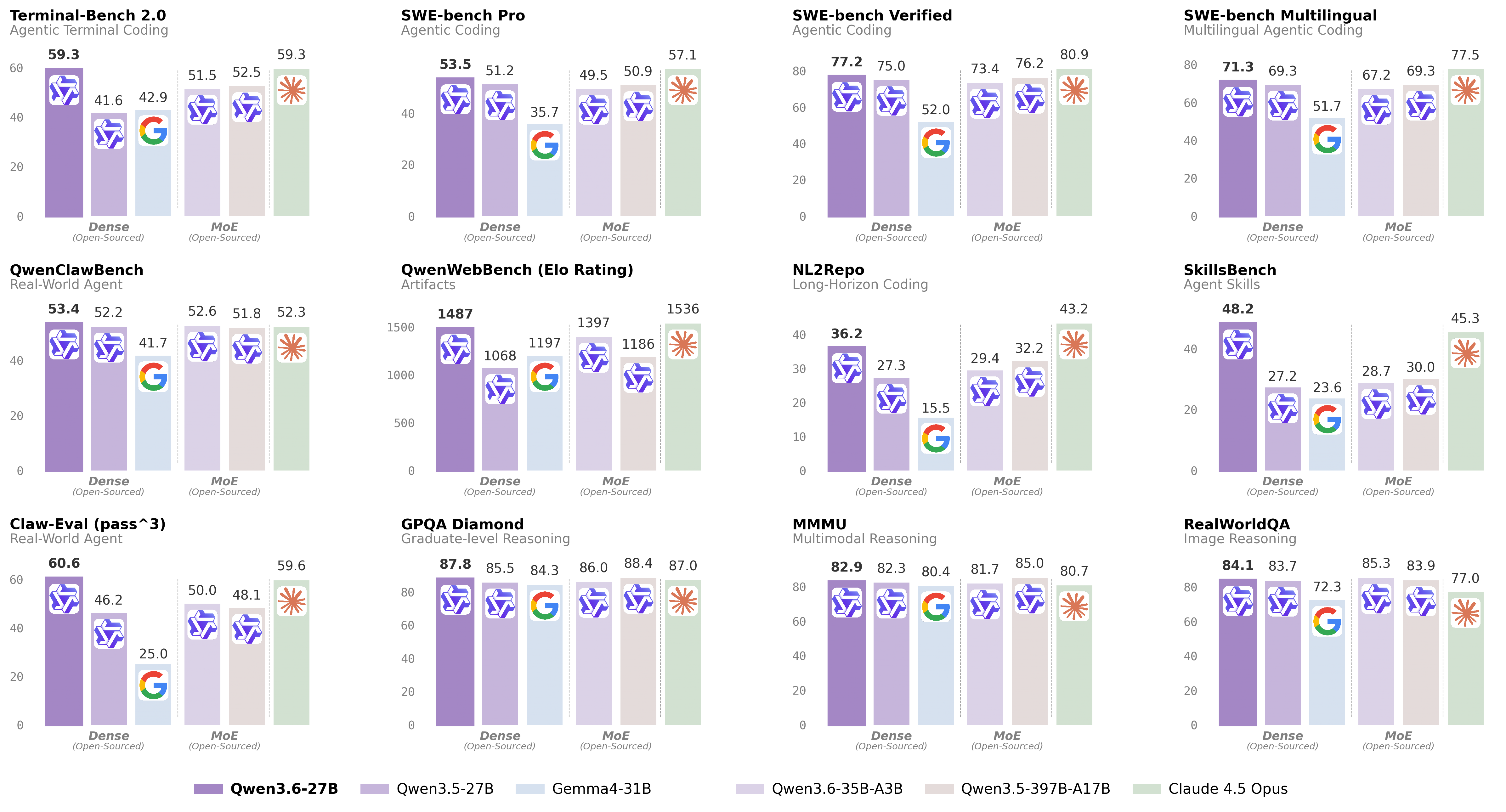
Qwen3.6-27B (dense) paired with its DFlash block-diffusion drafter for speculative decoding on the llama.cpp backend. DFlash gives its largest speedups on dense targets like this one. DFlash produces a whole block of draft tokens in a single forward pass and injects the target model's hidden states into the drafter's attention, which keeps the drafter tiny while making drafting GPU-friendly. The Q4_K_M file carries the full Qwen3.6-27B target; the ~1.8 GB Q8_0 drafter (`draft-dflash`) accelerates generation without changing the target's outputs. The drafter is not a standalone chat model: it only runs paired with the target, which is why both are bundled here. Flash attention is required for DFlash and is enabled in this config. A GPU is recommended. License: Apache 2.0.

Repository: localaiLicense: apache-2.0

qwen3.6-35b-a3b-dflash
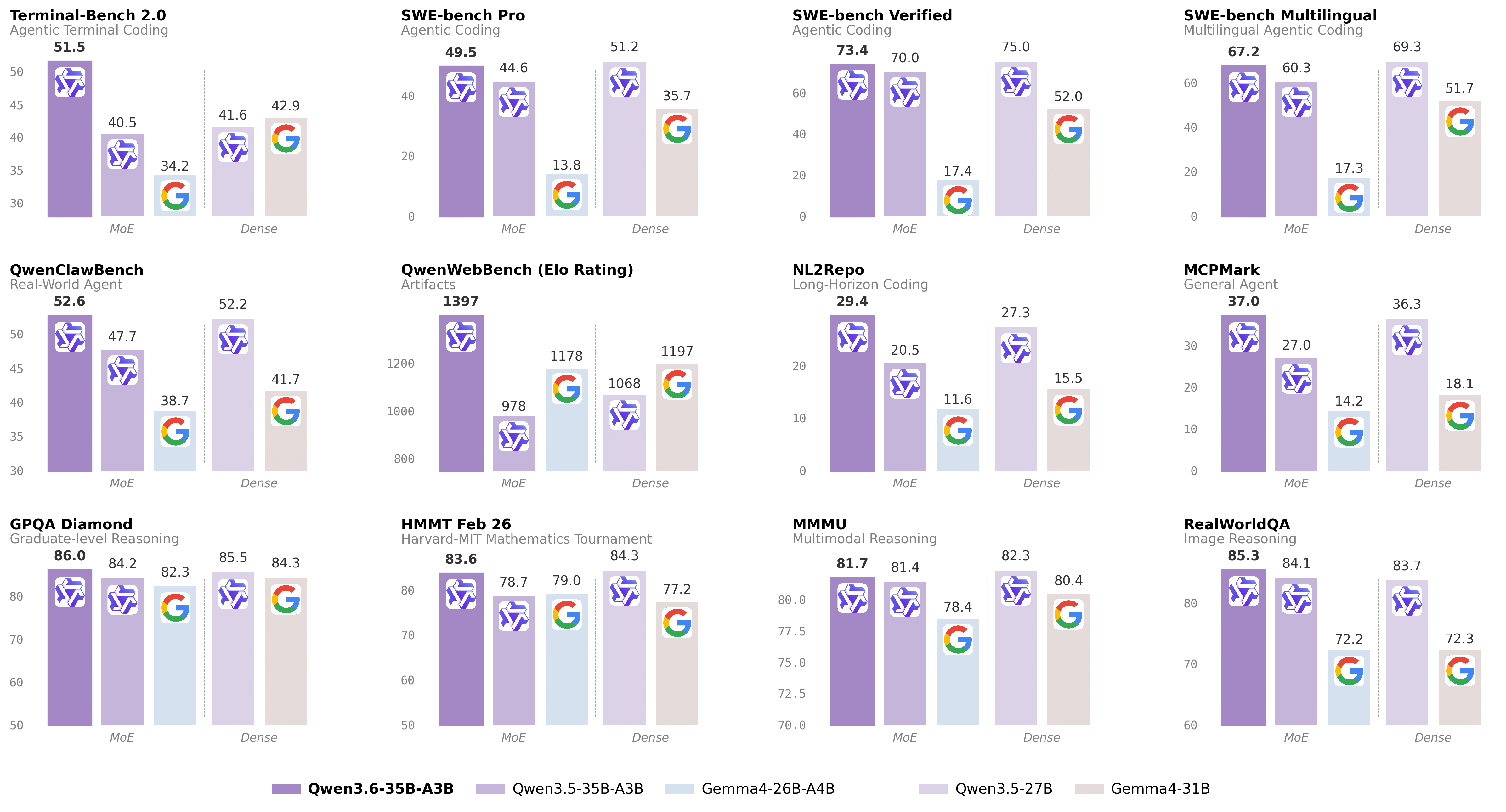
Qwen3.6-35B-A3B (Mixture-of-Experts, ~3B active per token) paired with its DFlash block-diffusion drafter for speculative decoding on the llama.cpp backend. DFlash speedups on MoE targets are smaller than on dense models, but still useful. DFlash produces a whole block of draft tokens in a single forward pass and injects the target model's hidden states into the drafter's attention, which keeps the drafter tiny while making drafting GPU-friendly. The UD-Q4_K_M file carries the full Qwen3.6-35B-A3B target; the ~0.4 GB Q8_0 drafter (`draft-dflash`) accelerates generation without changing the target's outputs. The drafter is not a standalone chat model: it only runs paired with the target, which is why both are bundled here. Flash attention is required for DFlash and is enabled in this config. A GPU is recommended. License: Apache 2.0.

Repository: localaiLicense: apache-2.0

lfm2.5-8b-a1b
Try LFM • Docs • LEAP • Discord # LFM2.5-8B-A1B LFM2.5 is a new family of hybrid models designed for on-device deployment. It builds on the LFM2 architecture with extended pre-training and reinforcement learning. - **On-device personal assistant**: Designed to power real-life applications, chaining tool calls, and following complex instructions on all devices. - **Compressed performance**: Competitive with much larger dense and MoE models on instruction following and agentic tasks. - **Unmatched throughput**: Fastest in its size class on both CPU and GPU inference, with day-one support for llama.cpp, MLX, vLLM, and SGLang. Find more information about LFM2.5-8B-A1B in our blog post. **AA-Omniscience Index (higher is better) rewards correct answers and penalizes hallucinations. Scores range from -100 to 100. See more results on Artificial Analysis.* ## 🗒️ Model Details LFM2.5-8B-A1B is a general-purpose text-only model with the following features: ...

Repository: localaiLicense: other

vllm-omni-z-image-turbo
Z-Image-Turbo via vLLM-Omni - A distilled version of Z-Image optimized for speed with only 8 NFEs. Offers sub-second inference latency on enterprise-grade H800 GPUs and fits within 16GB VRAM. Excels in photorealistic image generation, bilingual text rendering (English & Chinese), and robust instruction adherence.

Repository: localaiLicense: apache-2.0

longcat-video
LongCat-Video served by LocalAI's dedicated CUDA backend. Generates video from a text prompt or a start image. The SDPA attention path works without FlashAttention and is suitable for CUDA 13 ARM64 systems such as DGX Spark. This is a very large checkpoint (roughly 83 GB in Hugging Face storage) and requires Linux with an NVIDIA CUDA GPU plus substantial memory and disk.

Repository: localaiLicense: mit

longcat-video-avatar-1.5
LongCat-Video-Avatar-1.5 served by LocalAI's dedicated CUDA backend. Turns speech plus a prompt into an avatar video, optionally conditioning on a portrait, and continues across multiple segments for longer audio. Avatar generation also loads tokenizer, text encoder, and VAE components from LongCat-Video. Plan for very large downloads and substantial NVIDIA GPU or unified memory; CPU and macOS execution are unsupported.

Repository: localaiLicense: mit

z-image-turbo-diffusers
🚀 Z-Image-Turbo – A distilled version of Z-Image that matches or exceeds leading competitors with only 8 NFEs (Number of Function Evaluations). It offers ⚡️sub-second inference latency⚡️ on enterprise-grade H800 GPUs and fits comfortably within 16G VRAM consumer devices. It excels in photorealistic image generation, bilingual text rendering (English & Chinese), and robust instruction adherence.

Repository: localaiLicense: apache-2.0

allenai_olmo-3.1-32b-think
The **Olmo-3.1-32B-Think** model is a large language model (LLM) optimized for efficient inference using quantized versions. It is a quantized version of the original **allenai/Olmo-3.1-32B-Think** model, developed by **bartowski** using the **imatrix** quantization method. ### Key Features: - **Base Model**: `allenai/Olmo-3.1-32B-Think` (unquantized version). - **Quantized Versions**: Available in multiple formats (e.g., `Q6_K_L`, `Q4_1`, `bf16`) with varying precision (e.g., Q8_0, Q6_K_L, Q5_K_M). These are derived from the original model using the **imatrix calibration dataset**. - **Performance**: Optimized for low-memory usage and efficient inference on GPUs/CPUs. Recommended quantization types include `Q6_K_L` (near-perfect quality) or `Q4_K_M` (default, balanced performance). - **Downloads**: Available via Hugging Face CLI. Split into multiple files if needed for large models. - **License**: Apache-2.0. ### Recommended Quantization: - Use `Q6_K_L` for highest quality (near-perfect performance). - Use `Q4_K_M` for balanced performance and size. - Avoid lower-quality options (e.g., `Q3_K_S`) unless specific hardware constraints apply. This model is ideal for deploying on GPUs/CPUs with limited memory, leveraging efficient quantization for practical use cases.

Repository: localaiLicense: apache-2.0

ai21labs_ai21-jamba-reasoning-3b
AI21’s Jamba Reasoning 3B is a top-performing reasoning model that packs leading scores on intelligence benchmarks and highly-efficient processing into a compact 3B build. The hybrid design combines Transformer attention with Mamba (a state-space model). Mamba layers are more efficient for sequence processing, while attention layers capture complex dependencies. This mix reduces memory overhead, improves throughput, and makes the model run smoothly on laptops, GPUs, and even mobile devices, while maintainig impressive quality.

Repository: localaiLicense: apache-2.0

opengvlab_internvl3_5-30b-a3b
We introduce InternVL3.5, a new family of open-source multimodal models that significantly advances versatility, reasoning capability, and inference efficiency along the InternVL series. A key innovation is the Cascade Reinforcement Learning (Cascade RL) framework, which enhances reasoning through a two-stage process: offline RL for stable convergence and online RL for refined alignment. This coarse-to-fine training strategy leads to substantial improvements on downstream reasoning tasks, e.g., MMMU and MathVista. To optimize efficiency, we propose a Visual Resolution Router (ViR) that dynamically adjusts the resolution of visual tokens without compromising performance. Coupled with ViR, our Decoupled Vision-Language Deployment (DvD) strategy separates the vision encoder and language model across different GPUs, effectively balancing computational load. These contributions collectively enable InternVL3.5 to achieve up to a +16.0% gain in overall reasoning performance and a 4.05 ×\times× inference speedup compared to its predecessor, i.e., InternVL3. In addition, InternVL3.5 supports novel capabilities such as GUI interaction and embodied agency. Notably, our largest model, i.e., InternVL3.5-241B-A28B, attains state-of-the-art results among open-source MLLMs across general multimodal, reasoning, text, and agentic tasks—narrowing the performance gap with leading commercial models like GPT-5. All models and code are publicly released.

Repository: localaiLicense: apache-2.0

opengvlab_internvl3_5-30b-a3b-q8_0
We introduce InternVL3.5, a new family of open-source multimodal models that significantly advances versatility, reasoning capability, and inference efficiency along the InternVL series. A key innovation is the Cascade Reinforcement Learning (Cascade RL) framework, which enhances reasoning through a two-stage process: offline RL for stable convergence and online RL for refined alignment. This coarse-to-fine training strategy leads to substantial improvements on downstream reasoning tasks, e.g., MMMU and MathVista. To optimize efficiency, we propose a Visual Resolution Router (ViR) that dynamically adjusts the resolution of visual tokens without compromising performance. Coupled with ViR, our Decoupled Vision-Language Deployment (DvD) strategy separates the vision encoder and language model across different GPUs, effectively balancing computational load. These contributions collectively enable InternVL3.5 to achieve up to a +16.0% gain in overall reasoning performance and a 4.05 ×\times× inference speedup compared to its predecessor, i.e., InternVL3. In addition, InternVL3.5 supports novel capabilities such as GUI interaction and embodied agency. Notably, our largest model, i.e., InternVL3.5-241B-A28B, attains state-of-the-art results among open-source MLLMs across general multimodal, reasoning, text, and agentic tasks—narrowing the performance gap with leading commercial models like GPT-5. All models and code are publicly released.

Repository: localaiLicense: apache-2.0

opengvlab_internvl3_5-14b-q8_0
We introduce InternVL3.5, a new family of open-source multimodal models that significantly advances versatility, reasoning capability, and inference efficiency along the InternVL series. A key innovation is the Cascade Reinforcement Learning (Cascade RL) framework, which enhances reasoning through a two-stage process: offline RL for stable convergence and online RL for refined alignment. This coarse-to-fine training strategy leads to substantial improvements on downstream reasoning tasks, e.g., MMMU and MathVista. To optimize efficiency, we propose a Visual Resolution Router (ViR) that dynamically adjusts the resolution of visual tokens without compromising performance. Coupled with ViR, our Decoupled Vision-Language Deployment (DvD) strategy separates the vision encoder and language model across different GPUs, effectively balancing computational load. These contributions collectively enable InternVL3.5 to achieve up to a +16.0% gain in overall reasoning performance and a 4.05 ×\times× inference speedup compared to its predecessor, i.e., InternVL3. In addition, InternVL3.5 supports novel capabilities such as GUI interaction and embodied agency. Notably, our largest model, i.e., InternVL3.5-241B-A28B, attains state-of-the-art results among open-source MLLMs across general multimodal, reasoning, text, and agentic tasks—narrowing the performance gap with leading commercial models like GPT-5. All models and code are publicly released.

Repository: localaiLicense: apache-2.0

opengvlab_internvl3_5-14b
We introduce InternVL3.5, a new family of open-source multimodal models that significantly advances versatility, reasoning capability, and inference efficiency along the InternVL series. A key innovation is the Cascade Reinforcement Learning (Cascade RL) framework, which enhances reasoning through a two-stage process: offline RL for stable convergence and online RL for refined alignment. This coarse-to-fine training strategy leads to substantial improvements on downstream reasoning tasks, e.g., MMMU and MathVista. To optimize efficiency, we propose a Visual Resolution Router (ViR) that dynamically adjusts the resolution of visual tokens without compromising performance. Coupled with ViR, our Decoupled Vision-Language Deployment (DvD) strategy separates the vision encoder and language model across different GPUs, effectively balancing computational load. These contributions collectively enable InternVL3.5 to achieve up to a +16.0% gain in overall reasoning performance and a 4.05 ×\times× inference speedup compared to its predecessor, i.e., InternVL3. In addition, InternVL3.5 supports novel capabilities such as GUI interaction and embodied agency. Notably, our largest model, i.e., InternVL3.5-241B-A28B, attains state-of-the-art results among open-source MLLMs across general multimodal, reasoning, text, and agentic tasks—narrowing the performance gap with leading commercial models like GPT-5. All models and code are publicly released.

Repository: localaiLicense: apache-2.0

Page 1 of many